Words for a new year

I maintain a database of ideas, articles, and book passages that I never want to forget. Every day it gives me notes to review. Today, January 1, two passages about perspective and transformation surfaced. And they’re good words to mark the start of a new year.


The first passage is the preface of Rich Roll’s Finding Ultra, a book about how an alcoholic-turned-food-addict became one of the world’s top ultra endurance athletes after his 40th birthday.

โ€œThe mass of men lead lives of quiet desperation, and go to the grave with the song still in them.โ€ โ€”HENRY DAVID THOREAU

The American Dream is an elegant, aspirational ideal originally premised on egalitarianism: equal opportunity for all. A mandated right to seek self-improvement. An open door to pursue potential, and in turn, contribute the fruits of oneโ€™s journey for the benefit ofย all.

But along the way, the foundational ethos of this enchanting concept lies a smoldering carcass on the shoulder of a modern superhighway, supplanted by a relentless compulsion to accumulate and consume. The priority is no longer self-actualization. Nor is it contribution. Personal responsibility has been exchanged for victimhood. Challenge is to be avoided. Comfort is king.

And he who amasses the most wins.

Indeed, personhood has been reduced to consumerism. Our social currency is stuffโ€”worth dictated not by who we are but by what we own, fueled by a cultural mandate that forsakes the value of service, struggle, and authentic expression for the pursuit of luxury, instant gratification, and ease.

The implicit promise of this perverted paradigm? Happiness, of course. Peace of mind. Contentment.

This is perhaps the greatest lie ever perpetrated on humankind. Because stuff doesnโ€™t make one happy. Because the quest for status is rooted in ego. And because security is an illusion.

As a result we suffer. In turn, we inflict pain on others. And upon the planet at large.

Intellectually, we all know itโ€™s true. The key to our identity, and ultimately our happiness, cannot be found in what we own. Our quest is not to accumulate. Itโ€™s not to seek power. And itโ€™s not to remain safe…

Iโ€™ve been there. I too bought into the great lie. Blinded by its false promise, I spent years in pursuit of a life I didnโ€™t mindfully choose. But rather than do something about it, anything, I simply medicated myself to salve a pain I wasnโ€™t even consciously aware I harbored. Drugs, alcohol, fast foodโ€”you name it. Itโ€™s a path that took me to some very dark places. And itโ€™s a life that left me profoundly desperate, accelerating me to the grave without any awareness that deep down, lying dormant, was a song. A song yet to be discovered. A song yearning to be sung.

This book is about my search for that song. Itโ€™s a story about pain, and the unhealthy relationship with myself and the world that drove me to madness. And itโ€™s about the hard-fought journey to reclaim my life. A life of purpose, personal meaning, and service to others.

Through a grace that far exceeds my own power, I found a way out. Itโ€™s a solution that begins with how you feed the body. Extends to how you fuel the mind. And concludes with how you nourish the soul.

If my story stands for anything, it is that the human body, mind, and spirit are far more resilient than you can possibly imagine. My testimony is that each and every one of us is sitting atop vast reservoirs of untapped potential. Weโ€™re all capable of feats beyond our limited imagination. And personal growth isnโ€™t just possible, itโ€™s our mandate.

To echo Thoreau, we need not lead lives of quiet desperation. You too can break the chains of enslavement to take control of your health and destiny. You too can be better, do more, consume less, thrive. And along the way, achieve things beyond your imagination.

Itโ€™s never too late to change. You only have to do one thing: decide.

Today I sing my song. I sing it proudly, and loud.

My hope is that these pages will help you find your song. So you too can sing it with everything youโ€™ve got. Because you deserve it. And because the world needs you to be who you really are.


The second passage comes from Brandon Sanderson’s Oathbringer. For context, the speaker is a life-long warrior reaching middle age who has confronted the tension between who he was and who he wanted to be.

The most important words a man can say are, โ€œI will do better.โ€ These are not the most important words any man can say. I am a man, and they are what I needed to say.

The ancient code… says โ€œjourney before destination.โ€ Some may call it a simple platitude, but it is far more. A journey will have pain and failure. It is not only the steps forward that we must accept. It is the stumbles. The trials. The knowledge that we will fail. That we will hurt those around us. But if we stop, if we accept the person we are when we fall, the journey ends. That failure becomes our destination. To love the journey is to accept no such end. I have found, through painful experience, that the most important step a person can take is always the next one...

I ask not that you forgive me. Nor that you even understand. I ask only that you read or listen to these words. In this record, I hold nothing back. I will try not to shy away from difficult topics, or paint myself in a dishonestly heroic light. I will express only direct, even brutal, truth. You must know what I have done, and what those actions cost me.

For in this comes the lesson. It is not a lesson I claim to be able to teach. Experience herself is the great teacher, and you must seek her directly. You cannot have a spice described to you, but must taste it for yourself. However, with a dangerous spice, you can be warned to taste lightly. I would that your lesson may not be as painful as my own. I am no storyteller, to entertain you with whimsical yarns. I am no philosopher, to intrigue you with piercing questions. I am no poet, to delight you with clever allusions. I have no doubt that you are smarter than I am. I can only relate what happened, what I have done, and then let you draw conclusions. I will confess my murders before you. Most painfully, I have killed someone who loved me dearly. I will confess my heresy. I do not back down from the things I have said, regardless of what the ardents demand. Finally, I will confess my humanity. I have been named a monster, and do not deny those claims. I am the monster that I fear we all can become.

So sit back. Read, or listen, to someone who has passed between realms. Listen to the words of a fool. If they cannot make you less foolish, at least let them give you hope. For I, of all people, have changed.

A Coronavirus Meme-Check

A meme has been making its way around social media recently. Perhaps youโ€™ve seen it.

The reaction has been predictable. Many have passed it on in the hopes that it encourages people to wear a mask and avoid gatherings. Others have dismissed it, pointing out inaccuracies in the data.

Seeing the lack of dates and references myself, I decided to dig in to the numbers and see if the data match the meme. What follows is a look at the numbers behind the United States’ deadliest disasters, deadliest diseases, and the deadliest wars.

Disasters

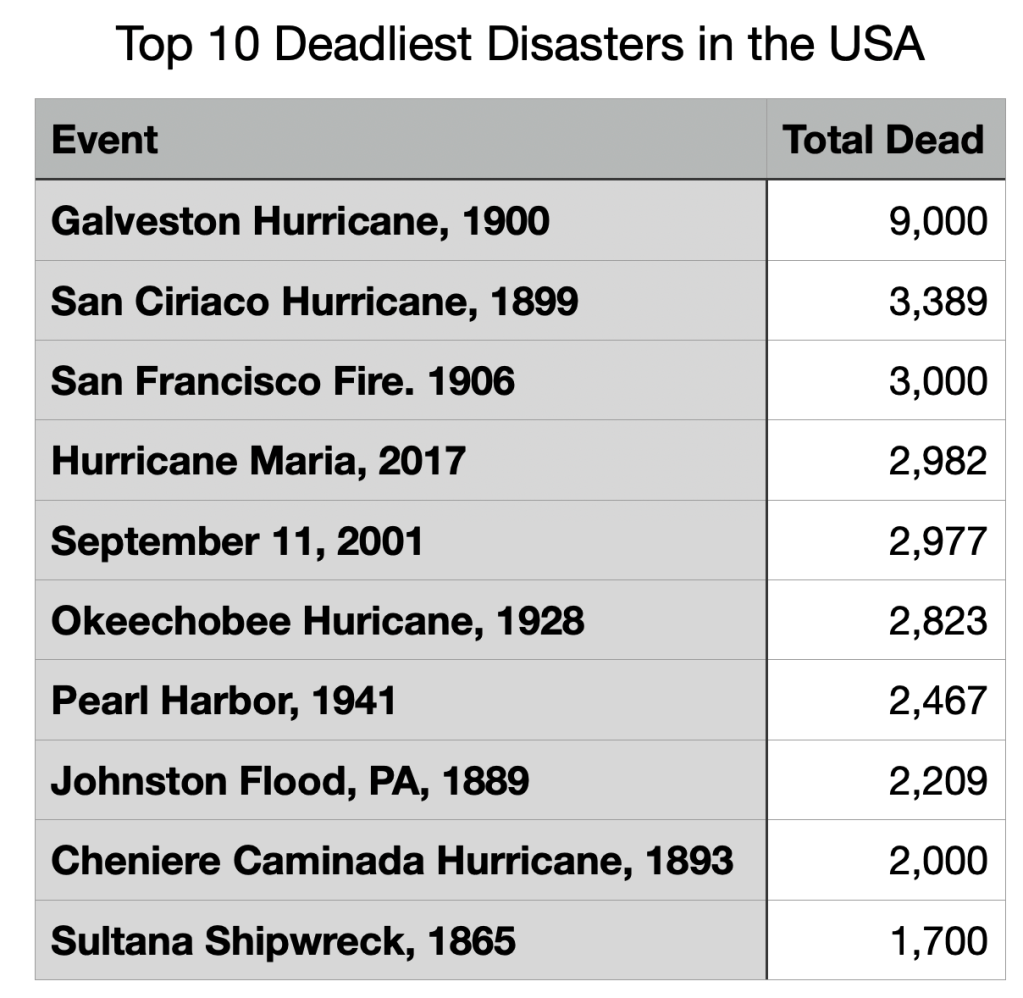
The Wikipedia page for the deadliest disasters in American history lists these as the top ten:

You’ll notice a mix of natural disasters and war-related events (9/11 and Pearl Harbor). The list doesn’t include death tolls from the Civil War. You’ll have to take that omission up with Wikipedia. Everyone can just note (since it was in the original meme) that there were 3,675 casualties at the Battle of Antietam on September 17, 1862. Additionally, I used the average (9,000) of the estimates of the death toll from the Galveston Hurricane, which range from 6,000 to 12,000.

Here is what that table looks like when we add in the last 10 days of United States coronavirus deaths, according to data from the New York Times, sorted by death count.

Take a second to look at those red numbers and let them sink in.

Four of the last ten days of coronavirus deaths would make it into the new top ten list of deadliest disasters in all of United States history. These specific days aren’t even the highest death tolls from coronavirus since February 3 when the US declared a state of emergency. This is just the last ten days. Given that today is 14 days since Thanksgiving, I wonder what will happen with these numbers going forward.

Also, the sum of casualties from the last ten days is 20,583. For those of us who remember that 2001 Tuesday morning in September, the death toll from the last week and a half is nearly the equivalent of seven September 11s. Seven.

Diseases and “Real” Health Issues

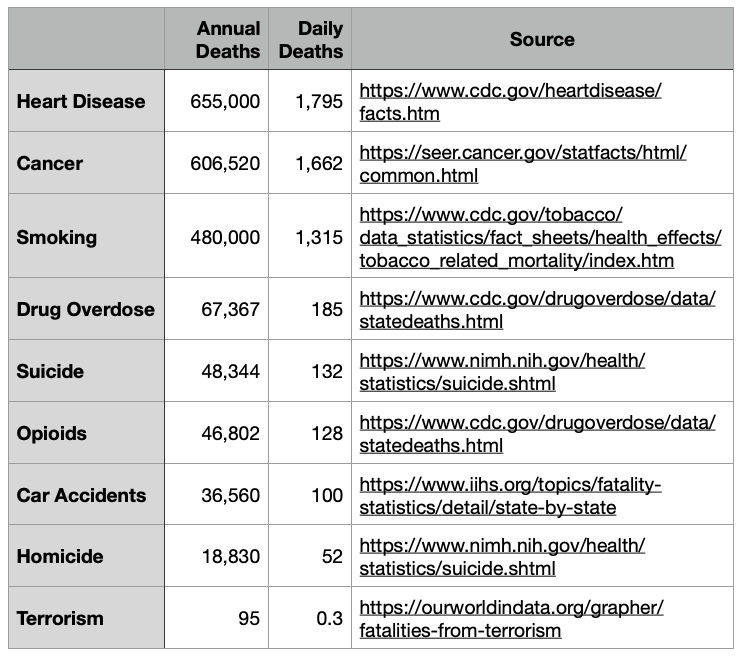
One response to the meme has been to claim that other maladies (cancer, the flu, suicide, etc.) are a much bigger deal than the coronavirus, either because of the death tolls or because coronavirus has such a high survival rate. Let’s take a look at these “real” problems from a numerical standpoint. The following table shows the 2018 death count for many of the health-related societal ills that often make the news, along with the source for each figure.

For comparison, the mean and median daily death rate from coronavirus in the last ten days are 2,277 and 2,620 respectively, both of which would put it at the top of this list by a wide margin.

Taking a more conservative measure, the coronavirus has killed an estimated 293,055 people in the USA since February 6 (the first supposed coronavirus death in the US). Dividing that total by the 308 days since February 6 gives an average death rate of 951, which would still make it more deadly than suicide, opioids, car accidents, homicides, and terrorism combined.

Moving away from issues that make the news, the following table shows the CDC’s top ten causes of death in the USA in 2018, with the conservative coronavirus daily death count.

Comparing all of these numbers, it is clear that coronavirus is currently more dangerous than many societal health issues. It is not the flu, having killed five times more than influenza and pneumonia, so far. It is killing Americans at a rate that merits national and individual attention and action.

Wars

How does the pandemic compare to American military casualties? What if the pandemic were a war? How would it stack up against World War II, or the American Revolution?

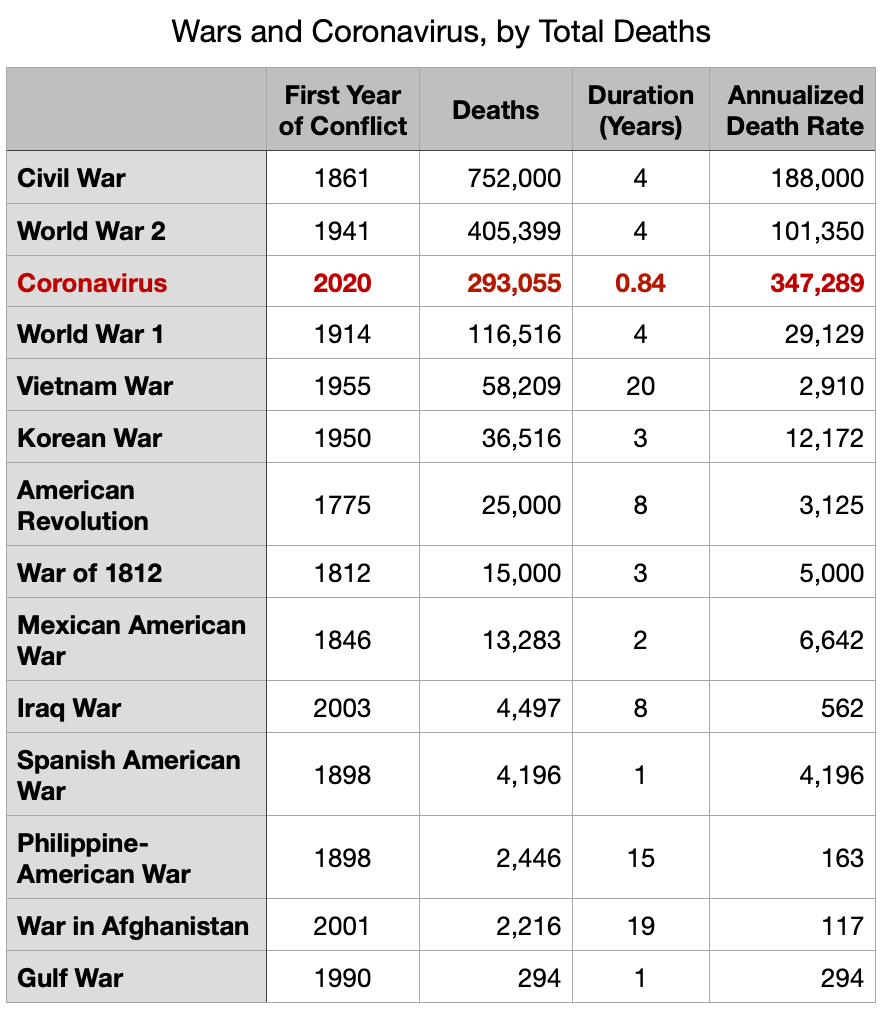
Since 1775, the United States has been involved in thirteen major wars. The table below includes all thirteen, shown chronologically in the table below with casualties, duration, and annualized death rate.

Source: Wikipedia’s “United States military causes of war” and
A Census Based Count of the Civil War Dead with some revised numbers for the Civil War

Sorting that same table by total casualties deaths gives us the following:

By total casualties, the Coronavirus War of 2020 would be the third deadliest military conflict in the country’s history, with a total death count higher than the sum of every war that is lower on the list (278,173).

Finally, sorting by annualized death rate (calculated using days since February 6) gives us the following:

If the current pandemic were a war, we’d be losing more American lives per year than in any previous military conflict in United States history. More than the Civil War. More than the World Wars.

In fact, the annualized death rate of the pandemic is nearly equal than the combined annualized rate of all 13 major military conflicts. Meaning, we are losing lives to coronavirus about as fast as if the United States were fighting every one of these wars (World War I, World War II, the American Revolution, the Civil War, Vietnam, the Korean War, etc.) at the same time.

So What?

What are we to make of these numbers? What do they mean? And how should we respond?

First, it means that the pandemic is a real problem. This analysis only looks at lives lost. There are some unanswered questions about the long-term side effects of Covid-19. A full cost analysis would also include the economic disruption that has come from an unexpected pandemic. In terms of casualties alone, the coronavirus ranks near the top of our country’s deadliest disasters, deadliest diseases, and deadliest wars.

What else does all of this mean?

If you want my take, this means war.

Our country is at war against the coronavirus. We are not at war with democrats or republicans. We are not at war with Fox News, OAN, or CNN. We are not at war with our neighbors. We are at war with an enemy that is killing Americans faster than any previous military conflict. The recent daily casualties are higher than the daily death tolls from cancer, heart disease, suicide, drugs, homicide, and terrorism.

What is both sad and alarming is that a number of our fellow citizens, including some of our local and national leaders, don’t believe in the war. For reasons that will be studied for years, a number of US citizens aren’t taking measures to combat the virus. Since the disease is contagious before it is symptomatic, and since few of us will die from it, those of us disregarding healthcare measures do so at the peril of our fellow Americans who might not be as lucky as we are. By refusing to fight, we are handing American lives over to the enemy at an increasing rate.

However, and this is important, those of us who refuse to fight are not the enemy. While it is frustrating that some don’t see how many people are dying, their surrender doesn’t invalidate the efforts of those of us who are still fighting. Personally, I’m trying not to let others’ inaction frustrate me. I remind myself that every effort helps. I remember those whose occupations and life situation prevent them from working from home or taking other precautions. As in all wars, there are some who cannot fight. It falls on those of who can to pull our weight and some of theirs.

I find some hope in the fact that these coronavirus numbers reflect only the past decisions we have made. What matters now is what we decide to do going forward. Every mask worn, every unnecessary outing avoided, and every lonely night spent once again at home decreases the spread of the pandemic. Vaccines are coming soon, but the war isn’t over yet.

It is time for us to band together, overcome our differences, and fight to end this pandemic — for our families, for our neighbors, for our country, for our economy, and for our freedom.

What To Do When Someone Is Wrong On The Internet

Iโ€™m not sure the rest of you have noticed, but there are these people on the internetโ€ฆ

And theyโ€™re wrong!

Crazy, right? Have you seen them around? Run into any of them while you dawdle on the internet?

Maybe theyโ€™ve commented on your wall, or maybe you have a mutual friend, and you just COULDNโ€™T let that comment go without a response. So you angrily concoct a retort, armed with the confidence that with your wit and your zingers and your logic, youโ€™ll put them in their place. But it never seems to work.

Hereโ€™s the thing.

You donโ€™t have to tell them theyโ€™re wrong. You donโ€™t have to convince them. The chance of you changing the mind of a stranger in a mouse-by comment is next to zilch. You donโ€™t have to waste any mental or emotional energy wondering how in the world their reality could be so drastically different from yours.

For the most partโ€ฆ

:::: deep breath :::

โ€ฆ you can just let them go.

You can take that time and energy and put it somewhere else. You can do some tangible good out in the world. You can get outside, away from the pixels and glowing screens. Facetime an old friend. Spend some time on that one project youโ€™ve been putting off. You can put that energy into chasing that crazy dream that scares you, just enough.

And so can I.

Maybe.

Image for post

Hope in the Desert

In need of a little motivation?

My brother, Neal Spackman, recently finished a decade-long endeavor, The Al Baydha Project, in Saudi Arabia. The goal was to turn a desert into an oasis. He describes it like this in the linked youtube video:

“The climate is hyper-arid, and the land is non-arable. The ecological degradation is extreme, with no significant natural resources to work with: no soil, no water, and almost no biological capital. It is a landscape made desolate by decades of desertification. Our toolsโ€ฆ were nothing but mountains and stone, sunlight, dust, and floods” (from an average 60mm a rain a year).

For nearly ten years, Neal and the 100 local bedouins on his team spent tens of thousands of hours in the heat and the sun with no certainty of success. To make a long story short, it worked! Neal made a prairie of grasses from desert, dust, sun, and a tiny bit of water. You really should watch the 20-minute video to see the story from start to finish. It is amazing.

I find extraordinary motivation in this story. The Al Baydha project shows the power of pushing forward when success is uncertain. None of us knows what will come from pursuing our current dreams. We’re somewhere in after starting but long from being able to see a finish line.

In that space, it’s tempting to give up. You’ve put in hundreds of doubt-filled hours over the years, and you’re not sure anything will come from your efforts. “Will this even work?” The doubt gnaws away at your willingness to push on, but you push on. You push on, driven by some combination of stubbornness and hope and the dream that got you started in the first place. You push on with no certainty of success.

After you’ve pressed on, after you’ve dealt with your demons, after you’ve persevered, and after the project is over, you’re able to see what has come from your efforts. At times that means a change of plans, a pivot to something new, but now with new skills and knowledge that you couldn’t have gained otherwise. And at times, you’re able to look back and say, “It worked!”

To anyone out there in that “in between”, to anyone who’s struggling, who’s gone back to school, or who’s exhausted from late nights, who’s uncertain of the outcome of all their work, who’s seen no rain for two years–to all of us chasing big dreams, don’t give up. Keep pushing on.

Remember the green that blossomed from dust and rock. There is hope for us in the desert.

Prayer of St. Francis as a Rulebook for Interacting with the World

The world, especially on the online world, can be so full of rage, misunderstanding, miscommunication, tribalism, racism, and partisanship. I’m not sure what to do about it yet, except to change how I interact with the world, both online and off.

When I was a teenager, I heard a choir sing the Prayer of St. Francis. Over the years, the lyrics frequently come to mind. Going forward, I will be using them to guide what I say, how I say it, and when I say it, both online and in person.

Lord, make me an instrument of thy peace;

where there is hatred, let me bring love;

where there is injury, pardon:

where there is doubt, faith;

where there is despair, hope

where there is darkness, light

where there is sadness, joy

O Divine Master,

grant that I may not so much seek to be consoled as to console;

to be understood, as to understand;

to be loved, as to love;

for it is in giving that we receive,

it is in pardoning that we are pardoned,

and it is in dying that we are born to Eternal Life.