What a Comatose Patient Taught Me About Healthcare

“Everyone who is born holds dual citizenship, in the kingdom of the well and in the kingdom of the sick. Although we all prefer to use only the good passport, sooner or later each of us is obliged, at least for a spell, to identify ourselves as citizens of that other place.” – Susan Sontag

Some years ago, I chased the dream of becoming a doctor. Part of that pursuit involved weekly volunteering from 8 to 11 p.m. in a hospital burn unit. Most nights, that meant answering phones, restocking supply carts, and peppering nurses with questions about diseases and treatments. Occasionally, I was called into patient rooms to assist with bandage changes.

One night, I learned a valuable lesson.

———

I was sitting at the reception desk when a nurse called me into a room to “turn” a patient—a routine procedure where we roll a patient in a medically induced coma to one side to change dressings and bedding, then turn them to the other to finish. I put on the requisite gown and gloves, and asked the nurse why the patient was sedated.

“She has TEN, which is short for Toxic Epidermal Necrolysis,” the nurse explained. “The body is attacking the skin as if it’s a foreign substance. She’s sedated because the pain would be unbearable. Our job is to stop the immune response and act as a second skin, layering bandages to protect her while she heals. That’ll take a few weeks, if things go well.”

As I helped roll the patient to one side, I was absorbed in the science at play in the room. I had never heard of TEN. I wanted to know the cellular and chemical mechanisms of the body’s immune response, the treatment protocols, and the stages of healing. I wanted to know the history of innovations that had made diagnosis and treatment possible. I was in awe of the human body, this marvelous machine, and the life-saving power of modern medicine

As we turned her to the other side, something on her right hand caught my eye – her thumbnail was painted a brilliant, glittery blue, sparkling under the sterile hospital light. 

In that instant, my perspective shifted. I wasn’t looking at a case of TEN; I was looking at a person. She was a daughter, a sibling, a student. She had likely painted her nails for a school dance or a Friday night out with friends. Her routines, her relationships, and her dreams had all been interrupted by a terrifying disease. 

I wasn’t just assisting with bandages. I was helping a person get back to her life outside the hospital. 

———

That quiet moment changed how I think about healthcare. It’s not just about medicine – it’s about people.

Healthcare is a complex, $5.3 trillion industry. It brings together some of the most advanced science, powerful technology, and sophisticated business models in the world. What modern medicine can do today is nothing short of miraculous. We can replace failing organs, rewire hearts, and decode strands of DNA. 

But if these tools and innovations aren’t designed and delivered with people at the center, something essential is lost. Excellence in business, science, and technology is necessary, but it’s not enough. True success means building systems where every interaction is human-centered, seamless, and supportive.

Because most of us will find ourselves in the hospital at some point, whether for a checkup, a surgery, or something far more serious. As Sontag wrote, we all hold dual citizenship in the kingdoms of the well and the sick. And when we’re called to present that second passport, what matters most isn’t just the care we receive, but how we experience the journey through that unfamiliar land.

That flash of glittering blue nail polish stays with me. It reminds me that behind every chart, treatment plan, and policy is a person, hoping to return to their life. Every strategic initiative, technology rollout, budget conversation, and operational redesign should begin and end with that person in mind.

Why?

Because people are the heart of healthcare.

Image generated with ChatGPT

A Coronavirus Meme-Check

A meme has been making its way around social media recently. Perhaps you’ve seen it.

The reaction has been predictable. Many have passed it on in the hopes that it encourages people to wear a mask and avoid gatherings. Others have dismissed it, pointing out inaccuracies in the data.

Seeing the lack of dates and references myself, I decided to dig in to the numbers and see if the data match the meme. What follows is a look at the numbers behind the United States’ deadliest disasters, deadliest diseases, and the deadliest wars.

Disasters

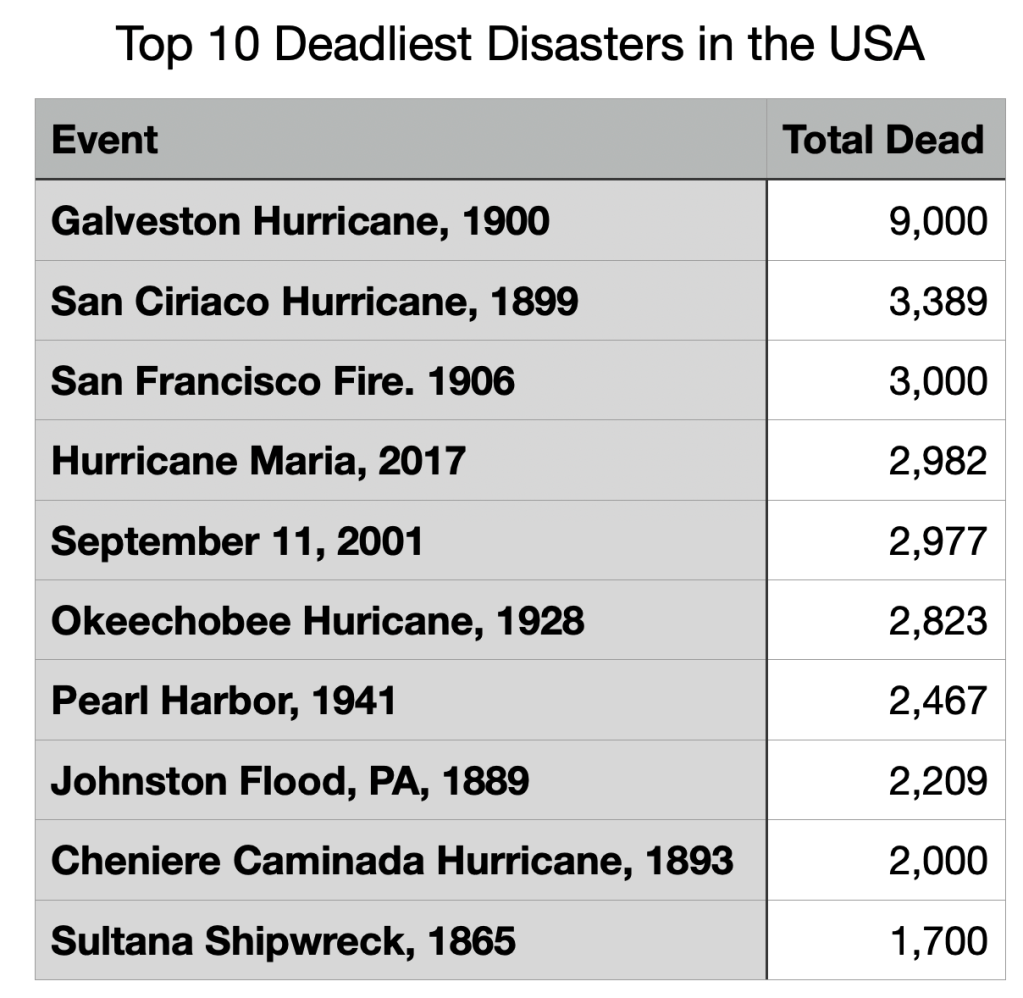
The Wikipedia page for the deadliest disasters in American history lists these as the top ten:

You’ll notice a mix of natural disasters and war-related events (9/11 and Pearl Harbor). The list doesn’t include death tolls from the Civil War. You’ll have to take that omission up with Wikipedia. Everyone can just note (since it was in the original meme) that there were 3,675 casualties at the Battle of Antietam on September 17, 1862. Additionally, I used the average (9,000) of the estimates of the death toll from the Galveston Hurricane, which range from 6,000 to 12,000.

Here is what that table looks like when we add in the last 10 days of United States coronavirus deaths, according to data from the New York Times, sorted by death count.

Take a second to look at those red numbers and let them sink in.

Four of the last ten days of coronavirus deaths would make it into the new top ten list of deadliest disasters in all of United States history. These specific days aren’t even the highest death tolls from coronavirus since February 3 when the US declared a state of emergency. This is just the last ten days. Given that today is 14 days since Thanksgiving, I wonder what will happen with these numbers going forward.

Also, the sum of casualties from the last ten days is 20,583. For those of us who remember that 2001 Tuesday morning in September, the death toll from the last week and a half is nearly the equivalent of seven September 11s. Seven.

Diseases and “Real” Health Issues

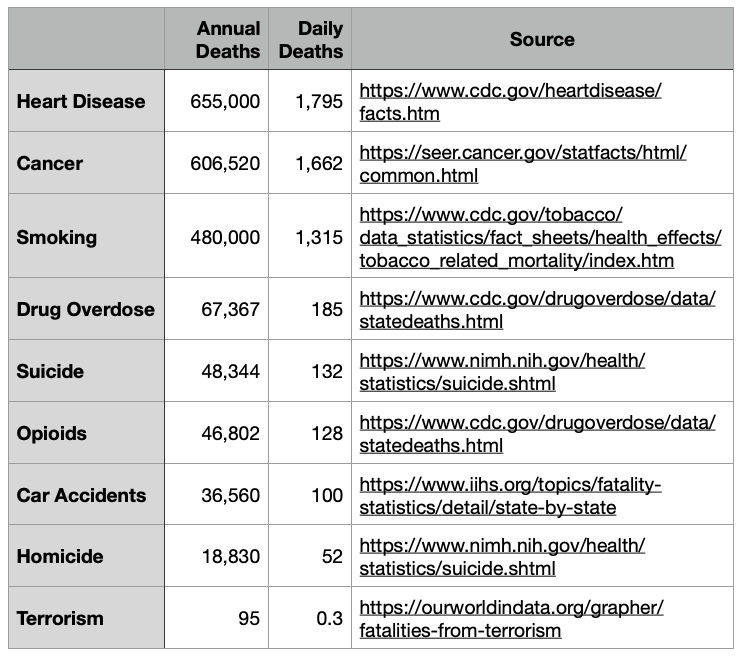
One response to the meme has been to claim that other maladies (cancer, the flu, suicide, etc.) are a much bigger deal than the coronavirus, either because of the death tolls or because coronavirus has such a high survival rate. Let’s take a look at these “real” problems from a numerical standpoint. The following table shows the 2018 death count for many of the health-related societal ills that often make the news, along with the source for each figure.

For comparison, the mean and median daily death rate from coronavirus in the last ten days are 2,277 and 2,620 respectively, both of which would put it at the top of this list by a wide margin.

Taking a more conservative measure, the coronavirus has killed an estimated 293,055 people in the USA since February 6 (the first supposed coronavirus death in the US). Dividing that total by the 308 days since February 6 gives an average death rate of 951, which would still make it more deadly than suicide, opioids, car accidents, homicides, and terrorism combined.

Moving away from issues that make the news, the following table shows the CDC’s top ten causes of death in the USA in 2018, with the conservative coronavirus daily death count.

Comparing all of these numbers, it is clear that coronavirus is currently more dangerous than many societal health issues. It is not the flu, having killed five times more than influenza and pneumonia, so far. It is killing Americans at a rate that merits national and individual attention and action.

Wars

How does the pandemic compare to American military casualties? What if the pandemic were a war? How would it stack up against World War II, or the American Revolution?

Since 1775, the United States has been involved in thirteen major wars. The table below includes all thirteen, shown chronologically in the table below with casualties, duration, and annualized death rate.

Source: Wikipedia’s “United States military causes of war” and
A Census Based Count of the Civil War Dead with some revised numbers for the Civil War

Sorting that same table by total casualties deaths gives us the following:

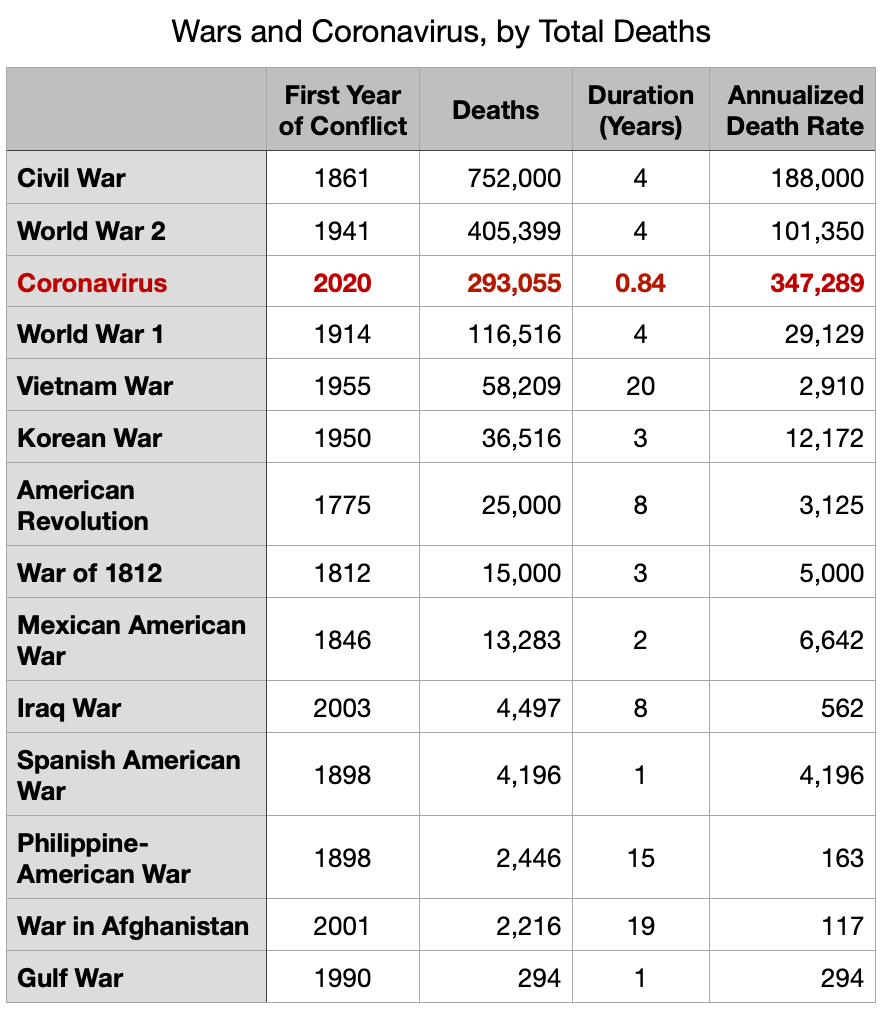
By total casualties, the Coronavirus War of 2020 would be the third deadliest military conflict in the country’s history, with a total death count higher than the sum of every war that is lower on the list (278,173).

Finally, sorting by annualized death rate (calculated using days since February 6) gives us the following:

If the current pandemic were a war, we’d be losing more American lives per year than in any previous military conflict in United States history. More than the Civil War. More than the World Wars.

In fact, the annualized death rate of the pandemic is nearly equal than the combined annualized rate of all 13 major military conflicts. Meaning, we are losing lives to coronavirus about as fast as if the United States were fighting every one of these wars (World War I, World War II, the American Revolution, the Civil War, Vietnam, the Korean War, etc.) at the same time.

So What?

What are we to make of these numbers? What do they mean? And how should we respond?

First, it means that the pandemic is a real problem. This analysis only looks at lives lost. There are some unanswered questions about the long-term side effects of Covid-19. A full cost analysis would also include the economic disruption that has come from an unexpected pandemic. In terms of casualties alone, the coronavirus ranks near the top of our country’s deadliest disasters, deadliest diseases, and deadliest wars.

What else does all of this mean?

If you want my take, this means war.

Our country is at war against the coronavirus. We are not at war with democrats or republicans. We are not at war with Fox News, OAN, or CNN. We are not at war with our neighbors. We are at war with an enemy that is killing Americans faster than any previous military conflict. The recent daily casualties are higher than the daily death tolls from cancer, heart disease, suicide, drugs, homicide, and terrorism.

What is both sad and alarming is that a number of our fellow citizens, including some of our local and national leaders, don’t believe in the war. For reasons that will be studied for years, a number of US citizens aren’t taking measures to combat the virus. Since the disease is contagious before it is symptomatic, and since few of us will die from it, those of us disregarding healthcare measures do so at the peril of our fellow Americans who might not be as lucky as we are. By refusing to fight, we are handing American lives over to the enemy at an increasing rate.

However, and this is important, those of us who refuse to fight are not the enemy. While it is frustrating that some don’t see how many people are dying, their surrender doesn’t invalidate the efforts of those of us who are still fighting. Personally, I’m trying not to let others’ inaction frustrate me. I remind myself that every effort helps. I remember those whose occupations and life situation prevent them from working from home or taking other precautions. As in all wars, there are some who cannot fight. It falls on those of who can to pull our weight and some of theirs.

I find some hope in the fact that these coronavirus numbers reflect only the past decisions we have made. What matters now is what we decide to do going forward. Every mask worn, every unnecessary outing avoided, and every lonely night spent once again at home decreases the spread of the pandemic. Vaccines are coming soon, but the war isn’t over yet.

It is time for us to band together, overcome our differences, and fight to end this pandemic — for our families, for our neighbors, for our country, for our economy, and for our freedom.